The latest WSJ report sheds new light on the origins of Trump’s Iranian debacle, which confirms virtually everything we had already guessed:
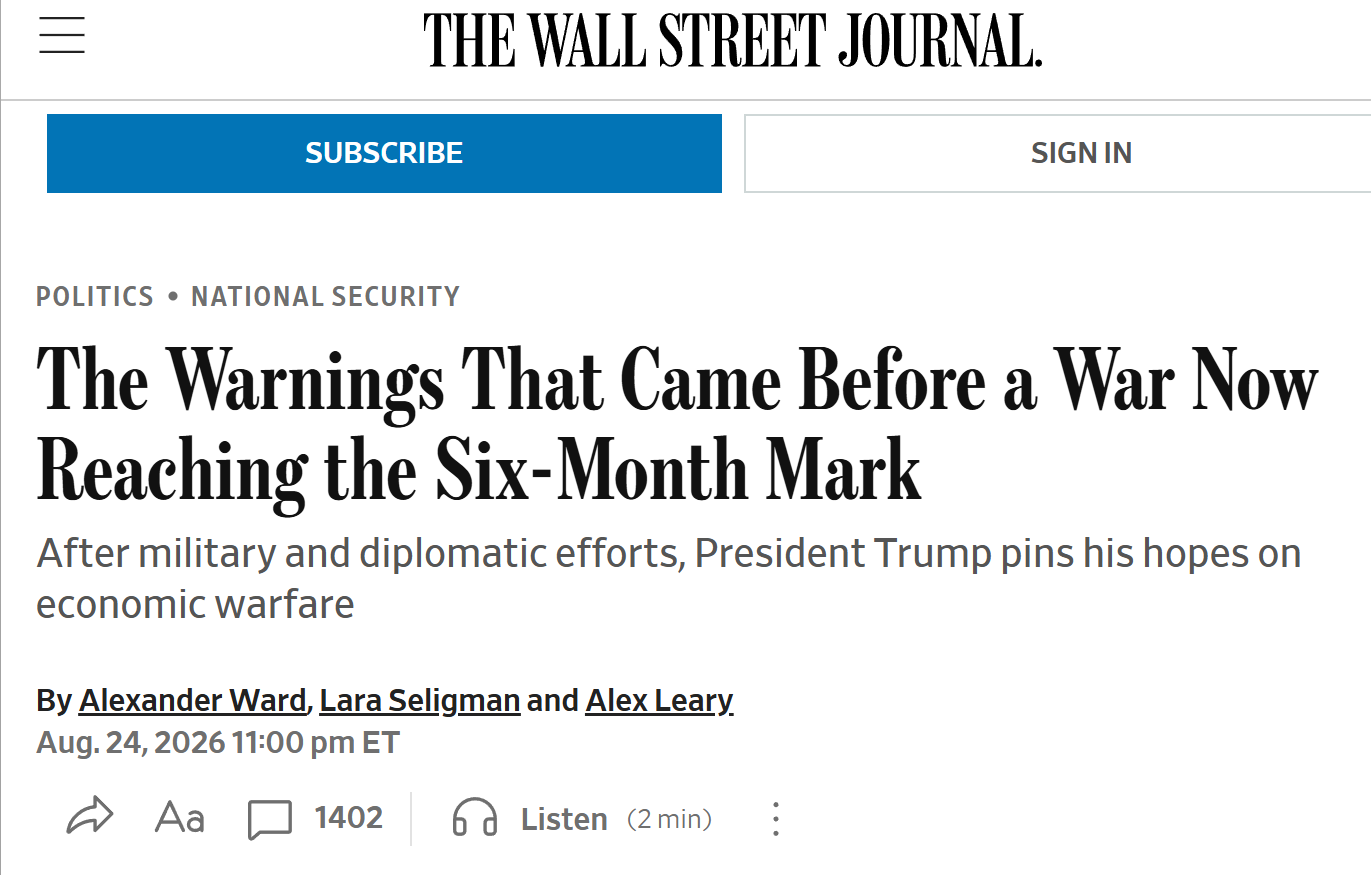
It begins by describing how Netanyahu reassured Trump Iran was at its “weakest point in decades”, while Trump’s own intel analysts via Gabbard’s DNI warned him that killing Khamenei would merely install much more hardline figures who would rush to close the Strait of Hormuz, amongst many other things which predicted the eventualities that ensued almost perfectly:
Then-Director of National Intelligence Tulsi Gabbard outlined assessments from America’s intelligence apparatus. According to people familiar with the meeting, she told Trump that killing Iran’s supreme leader would likely usher in a more hard-line regime open to acquiring nuclear weapons. Tehran would rush to close the Strait of Hormuz, destabilizing the global energy market. And it would strike U.S. forces and partners in the Middle East, prompting questions about American resolve and reliability with allies.
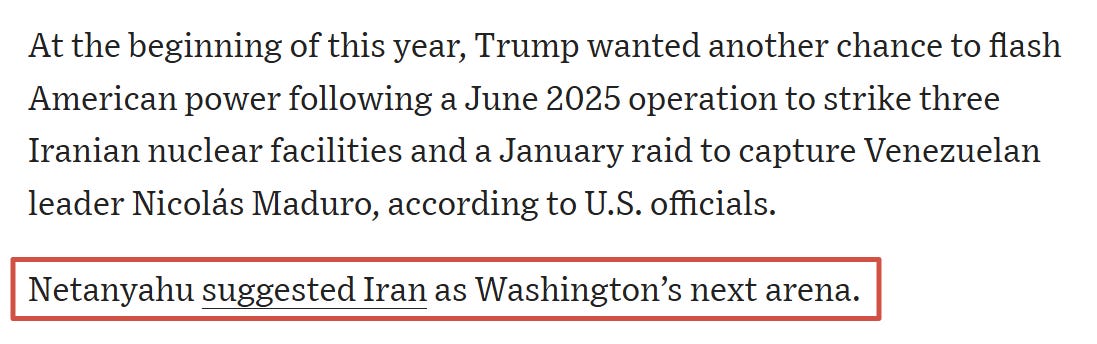
The article goes on to detail how Trump hubristically gloated over the killing of Khamenei only to see all the DNI’s predictions play out, after which a befuddled Trump turned irate at his advisors over his inability to understand why the US Armed Forces could not bring Iran to heel.
The outcome turned to the complete opposite of Trump’s vision, as multiple MSM outlets now confirm the Iran war caused “billions” in damage to irreplaceable US intelligence sites, which include surveillance equipment, CIA stations, radar networks, and more.
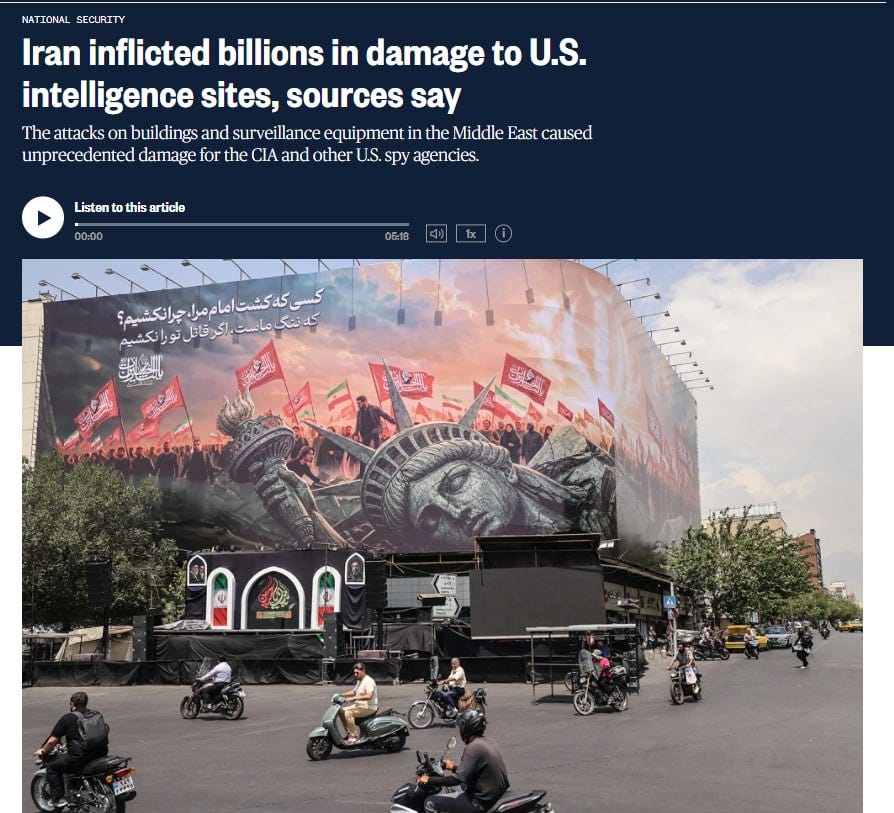
Iranian drones and missiles have struck “intelligence posts and surveillance hardware in the Middle East that is more extensive than any destruction America’s spy agencies have endured,” NBC News reported, citing four unnamed sources.
The damage is expected to cost billions to repair.
A CIA station in Riyadh, capital of Saudi Arabia, was struck by Iranian drones in March, Reuters reported last month. A separate CIA facility in eastern Iraq was also targeted.
Sources told NBC that additional sites had been hit but declined to provide further details. U.S. officials have also investigated whether Russia supplied Iran with drone technology or targeting information.
This comes amidst new reports that the US Navy is running out of funds due to the disastrous war:
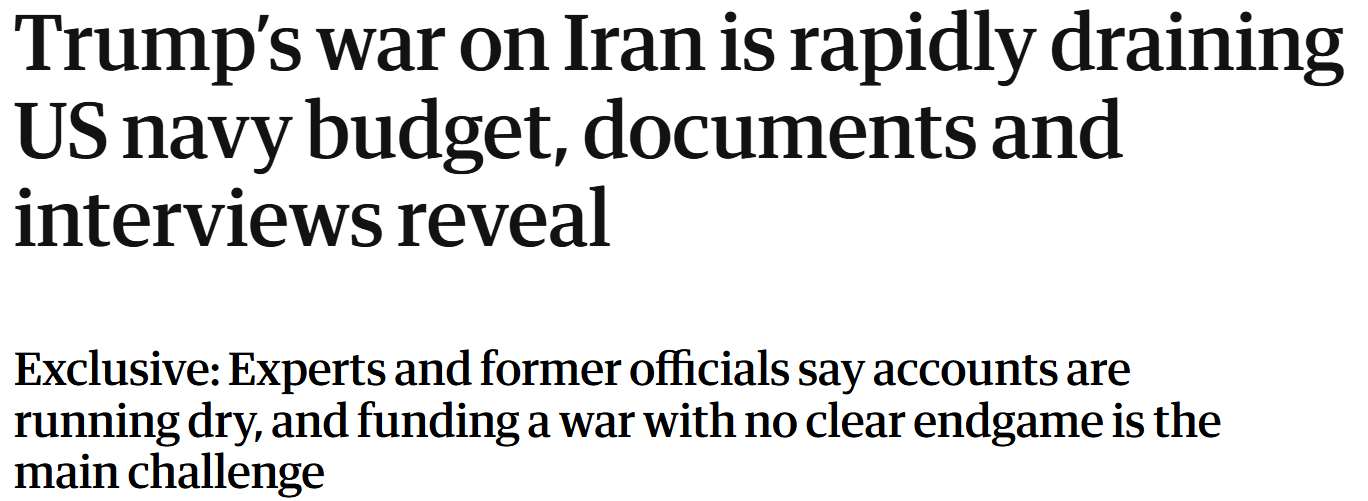
Donald Trump’s war on Iran has driven the US military into a severe financial crisis, with the US navy forced to transfer money from its payroll and other sources to cover the costs of combat, according to documents obtained by the Guardian, and interviews with navy officials, contractors and defense analysts.

Of interest is their statement that “non-emergency maintenance” is being deferred due to the cash crunch:
Experts and former officials say the accounts are running dry. “The piggy bank is broken,” said Harlan Ullman, a retired naval officer. Ullman is a member of the National Commission for the Future of the Navy but he said he is not speaking on the commission’s behalf.
One official and one navy contractor said non-emergency maintenance on shore-based facilities has been deferred because of the cash crunch.
Though they’re referring to “shore-based facilities”, it wouldn’t be surprising if this extends to virtually everything, which would explain the sad condition of US ships of late. Expect the US military to look increasingly run-down in the future as the repercussions of this mess slowly spread with the usual delayed effect of a gargantuan organization.
To further twist the knife on the Trump presidency’s magnum opus, WSJ reports that the US’s latest boasts of oil “pouring through Hormuz” are again nothing but hot air:
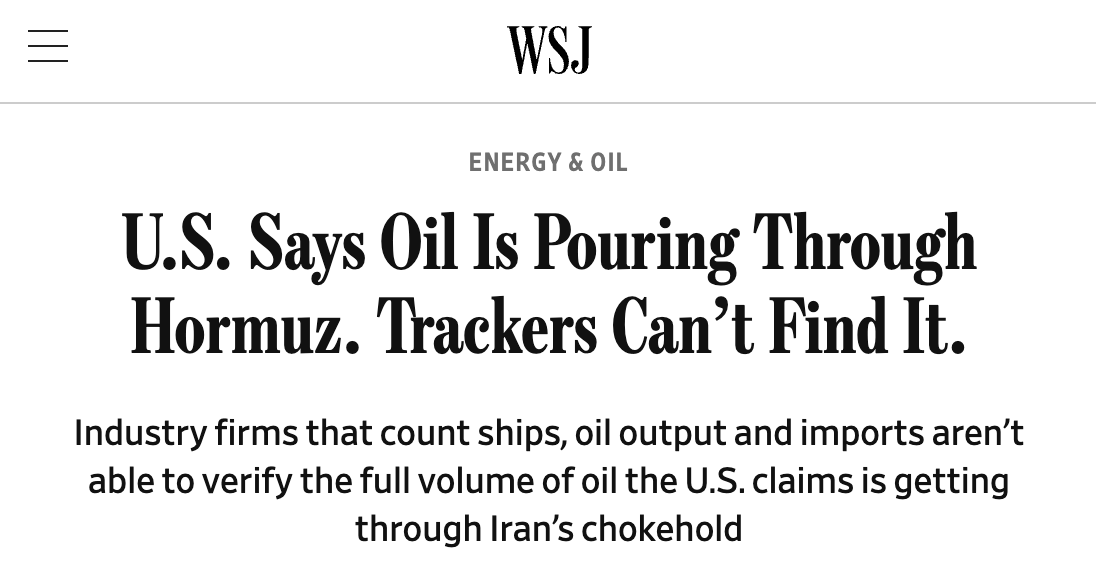
DUBAI—The Trump administration says large volumes of oil are slipping through the Strait of Hormuz. The trackers whose job it is to count the world’s oil shipments see much less.
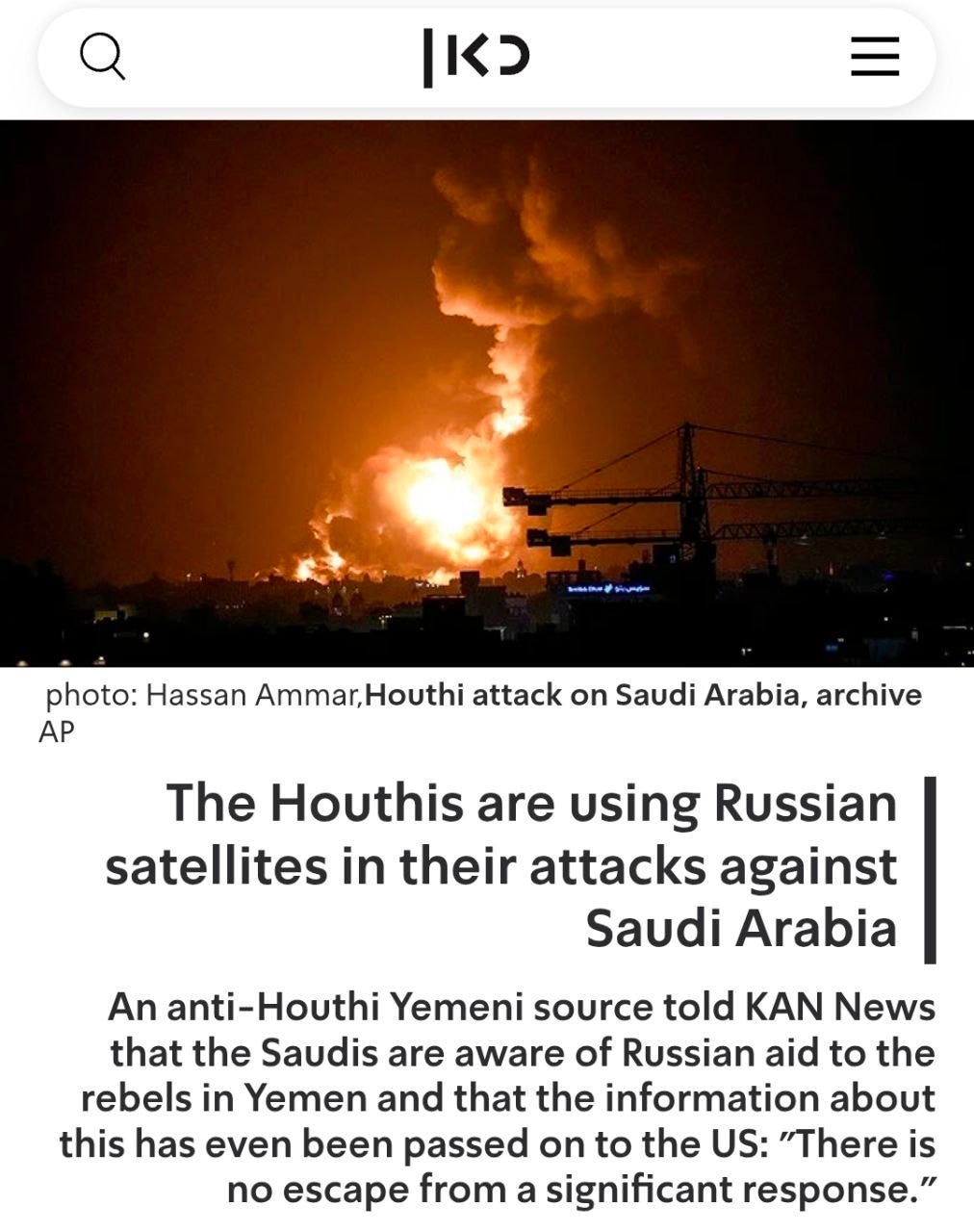
Given the directionless nature of Trump’s ongoing Hormuz play, it gives some credibility to rumors that CIA Director Ratcliffe’s visit to Moscow had something to do with warning Russia to stop supplying Iran with various forms of help. Perhaps in his desperation to break out of the deadlock, Trump sent Ratcliffe to plead for Russia to back off in exchange for some offer, so that Trump can cinch up Hormuz with a “victory” and call it a day.
After all, in recent weeks there have been various reports of the types of help Russia is providing, not least of which being to the Houthis—from Israeli news channels:
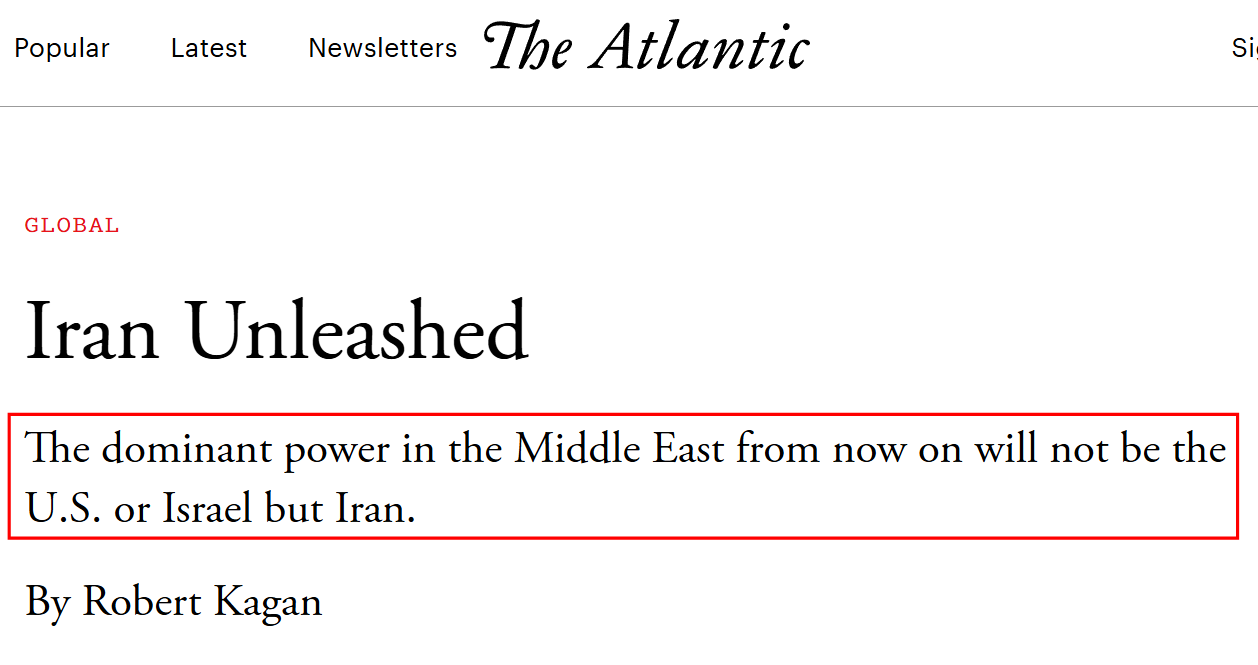
Suddenly ever the busy bee, Robert Kagan has penned another piece for the Atlantic wherein he peremptorily declares that Iran will henceforth be the dominant power in the Middle East:
It seems odd that he’s been frantically scribbling out so many pieces of late, in a swoon of paranoia or desperation. Often such figures pen these fear-monger pieces disingenuously, feigning some declarative “doom” reality when their true intention is to spur action to prevent the very result they’re railing about. Is this the case here?
Kagan writes:
For years, Iran confronted a balance of power in the Middle East that tilted against it. The region was dominated by a hostile American superpower, a nuclear-armed and militarily superior Israel, and significant local actors—Egypt, Saudi Arabia, the United Arab Emirates—that were strategically and economically aligned with the United States.
Today finds Iran in entirely new circumstances. It has gone head-to-head with the superpower and Israel, withstood a pounding from their most advanced weapons, and more than survived. As a result, Iran has, with American help, completely reconfigured the power structure of the Middle East and the Persian Gulf. The dominant power in the region going forward will be Iran, not the U.S. or Israel. Neighboring countries are already making their adjustments to this new reality. More distant powers will too. For years, the world has been dealing with an Iran constrained. It will now discover what Iran unleashed looks like.
What we can at least say is, no matter his intention, the conclusion is certainly objectively correct.
Kagan goes on to explain that when Israel attempted to shut down Iran’s gas production, the blowback was so sudden and powerful that it immediately sent Trump TACOing into a ceasefire:
Yet through all of this, the regime has survived and made no concessions. On the contrary, Iran exposed America’s Achilles’ heel: the vulnerability of Iran’s neighbors. A major turning point came in mid-March, when Israel attacked Iran’s South Pars gas field, and Iran retaliated against Qatar’s Ras Laffan complex, the world’s largest liquefied-natural-gas facility. The attack showed that although Iran obviously could not defeat the United States in an air war, Iranian missiles and drones could inflict enough damage on the oil-and-gas infrastructure of the Gulf to plunge the world into a prolonged economic crisis. The Gulf States understood this immediately, and so did Trump. He halted attacks on Iranian energy targets, ordered a reluctant Israel to do the same, and soon brought the larger campaign to a stop without extracting a single Iranian concession. Ever since, and despite many threats, Trump has not once ordered another strike against Iranian energy infrastructure.
In short, Iran proved to hold the most powerful leverage of all.
He goes on to admit that the MOU signed in June was a clear Iranian victory that declared “that the Islamic Republic of Iran, and no other nation, would “make arrangements” for the “safe passage of commercial vessels” through the Strait of Hormuz. In dialogue with Oman, without intermediaries or other participants, Iran would determine the strait’s administration “in line with the applicable international law and the sovereign rights of coastal states.”
The kicker, Kagan notes, is that Iran didn’t even really need the MOU, and knew the US had no cards to play and would cut tail with or without it:
In retrospect, Iran’s leaders do not seem to have believed that they needed the MOU. Supreme Leader Mojtaba Khamenei reportedly had to be persuaded by President Masoud Pezeshkian to sign it. Tehran’s relative indifference was understandable: The American concessions reflected such desperation to end the war that the Iranians could well have expected that the U.S. would eventually retreat, with or without a deal.
The US now fears escalation more than Iran does, Kagan correctly notes.
Now as for Trump’s pitiful “sanctions” and newly laid strategy of suffocating Iran via gradual economic means, Kagan writes this is rank delusion:
The idea that, having survived both military strikes and sanctions, Iran will now succumb to sanctions alone is deluded. Mojtaba has overhauled Iran’s national-security leadership and installed veterans of the Islamic Revolutionary Guard Corps in top positions. Former IRGC Commander Mohsen Rezaei now heads the Supreme National Security Council, and other hard-line security officials have been elevated. The regime emerging from the war is being reorganized by men who believe that Iran survived an American-Israeli attempt to destroy it and that defiance, not compromise, produced victory.
With his known perspicacity, Kagan outlines why Iran’s control of the Strait is an even more powerful weapon than a nuclear device, which is strictly deterrent in nature:
Iran’s control of the Strait of Hormuz is a more useful instrument of power than a nuclear weapon would be. A nuclear weapon might deter an attack, but control of the strait gives Iran leverage every day, over dozens of countries. With it, Iran can reward friends, punish enemies, extract revenue, force the loosening of sanctions, and make governments think twice before opposing Iranian policies. It can do all of this without firing a shot, and while preserving the ability to threaten violence when necessary.
Toward the end Kagan touches on another important repercussion of US’s historic failure in Iran—the fact that it exposed America as a paper tiger, which will have compounding effects in other regions throughout the world:
The effects will extend far beyond the Middle East. American allies in Asia and Europe can see that a relatively brief war against a second-rank power has consumed much of America’s supply of the weapons needed for missile defense. They can see that the United States began a war it could not finish, exposed its partners to retaliation, and then stopped when the costs became too great. Beijing’s conclusions about Taiwan, and Moscow’s conclusions about Europe, may be impossible to know. But America’s allies will inevitably be asking whether Washington has the weapons, stamina, and political will to sustain another major conflict. In fact, they already are.
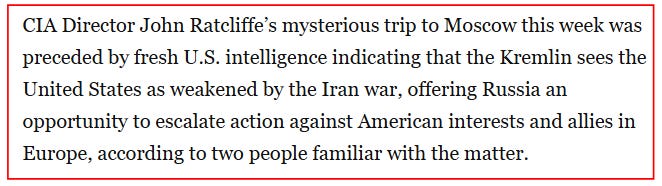
This comes particularly timely today as it was fascinatingly revealed—at least according to NYT and WaPo—that Ratcliffe’s “secret trip” to Moscow yesterday was spurred by Washington’s fear that Russia now views US as so weakened by its Iran defeat, that it could inspire Putin to “like his chances” in having a go against a NATO state:
How the @nytimes and @washingtonpost describe the message CIA Director Ratcliffe conveyed to Russian officials during his trip to Moscow. "John Ratcliffe, the C.I.A. director, made a secretive visit to Moscow this week to privately share his bleak assessment of the state of the
7:19 PM · Aug 27, 2026 · 53K Views
28 Replies · 80 Reposts · 380 Likes
Read the highlighted carefully:
"CIA Director John Ratcliffe’s mysterious trip to Moscow this week was preceded by fresh U.S. intelligence indicating that the Kremlin sees the United States as weakened by the Iran war, offering Russia an opportunity to escalate action against American interests and allies in Europe, according to two people familiar with the matter...
You can’t make this up:
Ratcliffe’s trip to Moscow was 'less about Putin being in a corner' because his army has failed to break a stalemate on the Ukraine battlefield 'and more because Russia assesses we are depleted and can’t intervene,' one of the people familiar said."
So, Ratcliffe desperately flew to reassure Russia that the US is not in fact a paper tiger, and to shake a stick at Putin to remind him that despite humiliatingly having the floor wiped with it by a middle power, the US still means business.
If true, this is a rather shocking and embarrassing turn of events. It effectively would mean that Ratcliffe was sent as errand-boy to basically say:
“Listen, I know our empire looks to be on its last legs, but don’t forget: we still have NUKES (aging though they may be, run by floppy disks from the ‘70s, and stashed in siloes manned by drug addicts).”
Well, if that was his message, it certainly would have been received with lip trembling delight by Russian interlocutors.
When you have to fly around the world to ‘remind’ your adversaries of your strength, it may be the first major sign that the sun has begun to set on your empire.
Your support is invaluable. If you enjoyed the read, I would greatly appreciate if you subscribed to a monthly/yearly pledge to support my work, so that I may continue providing you with detailed, incisive reports like this one.
Alternatively, you can tip here: buymeacoffee.com/Simplicius